

AI content moderation is the automated scanning of text, images, audio, and video to flag policy violations before or after they reach an audience. Treat it as a high-volume detection signal, not a verdict: the accurate model routes ambiguous or high-stakes cases to trained human reviewers inside a system with logged decisions, defined roles, and a working appeals path.
TL;DR:
- Splitting moderation models from policy clarity can cause enforcement issues, even with advanced filtering systems in place.
- Hybrid moderation systems, combining AI auto-resolutions with human review, are most common because they balance scale and context.
- Implementing a full audit trail, review interface, and escalation workflows is critical for trust, compliance, and handling regulatory demands.
- Bias, hallucinations, reviewer fatigue, and technical integration challenges pose significant risks, requiring ongoing metrics and careful policy alignment.
- Prioritizing a strong appeals process and proper moderation workflow design outweighs minor differences in classification accuracy among vendors.
Table of Contents
- What Is AI Content Moderation and Who Relies on It?
- What Are the Six Content Moderation Models?
- How Does AI Moderation Actually Work Under the Hood?
- Why a Moderation API Alone Will Not Protect You
- What Can Go Wrong: Risks and Regulatory Pressure
- How Do You Deploy AI Moderation Without Breaking Trust?
- What Tools Exist for AI Content Moderation Today?
- What Comes Next in AI-Driven Content Review
- How Should You Handle User Privacy During Moderation?
- Why Is Integrating Moderation Into Existing Platforms So Hard?
- What Have Real Moderation Failures and Wins Taught Us?
- The Perspective Nobody Wants to Hear About Moderation Vendors
- Sources
What Is AI Content Moderation and Who Relies on It?
Moderation and content policy enforcement are not the same thing. Moderation is the mechanism, the classifiers, review queues, and escalation rules that catch violations. Policy is the rulebook that defines what counts as a violation in the first place. A platform can have airtight AI moderation and still fail its users if the policy itself is vague or inconsistently applied.
The scope has expanded well past text posts. Modern systems screen user-generated comments and reviews, AI-generated images and video, livestreams, voice channels in gaming and social apps, and increasingly, content that blends all four in a single upload. A meme with an audio track and a caption needs a pipeline that reads image, sound, and language together, not three separate checks bolted together after the fact.
Three groups drive the investment in moderation infrastructure, each for a different reason:
- Trust and safety teams care about user harm reduction and platform reputation.
- Legal and compliance officers care about defensibility against regulatory action and litigation.
- Product and engineering leaders care about latency, cost per item reviewed, and not breaking the user experience with over-aggressive filtering.
Those goals occasionally pull in opposite directions, which is exactly why the operational design matters more than the model choice.
What Are the Six Content Moderation Models?
Every automated content filtering approach falls into one of six operational patterns, and TechTarget's breakdown of these models remains the clearest map of the trade-offs involved. None of them is universally correct. The choice depends on how much risk a platform can tolerate before content goes live.
- Pre-moderation reviews every item before publication. It offers the strongest guarantee against harmful content reaching an audience, but it slows the user experience to a crawl. Dating apps screening profile photos before approval, and children's platforms vetting every comment, typically staff this with dedicated review teams working against a queue.
- Post-moderation publishes content immediately and reviews it afterward. Users get instant gratification; the platform accepts a window where violations are visible before removal. Large social platforms use this pattern by necessity. At scale, waiting to pre-clear every post is not viable.
- Reactive moderation relies on user reports to trigger review. It is cheap to run and scales naturally with community size, but it only catches what someone bothers to flag, and coordinated bad actors know exactly how to stay under the radar.
- Distributed moderation spreads review authority across volunteer or elected community moderators, common on forums and subreddit-style platforms. It scales moderation labor without payroll costs but opens the door to inconsistent enforcement and occasional moderator bias.
- User-only moderation puts filtering entirely in the hands of individual users, muting or blocking at the account level with no platform-wide removal. It respects autonomy but does nothing to stop harmful content from spreading to others.
- Hybrid moderation lets AI auto-resolve high-confidence, low-ambiguity cases while routing gray areas to human reviewers. This is the pattern nearly every mature platform converges on, because pure automation misses context and pure human review cannot scale to millions of daily posts.
How Does AI Moderation Actually Work Under the Hood?
The technology stack has moved through three distinct generations. Early systems relied on keyword blocklists, easy to build, trivially easy to evade with misspellings or emoji substitution. Machine learning classifiers replaced blocklists with pattern recognition trained on labeled examples, catching variations blocklists missed. The current generation adds large language models and computer vision that reason about context, sarcasm, and intent rather than just matching patterns.
A typical pipeline runs four stages: ingest the content, analyze it across relevant modalities (text classifiers, image models, audio transcription feeding back into text analysis), generate a confidence score per policy category, then route based on that score. High-confidence violations get auto-actioned. Low-confidence or borderline scores get queued for a human reviewer.
- OpenAI's moderation endpoint classifies text and images across policy categories and remains free to use, which makes it a common first stop for teams building this pipeline.
- Multimodal fusion models increasingly analyze image, audio, and text together instead of running separate checks and merging results after the fact.
- Newer research points toward compact models that pair a safety label with a short written justification, called a reasoning trace, so a human auditor can see why the system flagged something without reverse-engineering a black box.
Reasoning traces matter more than they sound. A model that outputs "flagged: harassment" tells a reviewer nothing. A model that outputs "flagged: harassment, because the phrase targets a protected characteristic in a threatening context" gives a reviewer, and later an auditor or regulator, something to actually evaluate. Early research into compact multimodal safety moderators, documented in a Nemotron paper on arXiv, points toward exactly this kind of low-latency, explainable scoring as the next step for production systems.
Why a Moderation API Alone Will Not Protect You
A raw classification endpoint tells you whether content violates a policy. It does not tell you who reviewed the borderline case, when the policy changed, or how a user contested a takedown. That gap is where platforms get burned, not in the model's accuracy, but in the absence of a system around it.
Practitioners building production moderation stacks consistently point to the same missing layer: a review interface, audit trail, and role structure that a bare API cannot provide on its own. Vendors like Vettly and Cinder have built entire product categories around exactly this gap, offering decision logs, policy versioning, and escalation workflows designed for teams running moderation as a full-time operation rather than a one-off integration.
The components a production system needs, at minimum:
- A review UI where human moderators see flagged content alongside the AI's confidence score and reasoning, not just a raw text dump.
- A queueing system that prioritizes by severity, so a credible threat does not sit behind a thousand spam reports.
- Policy versioning that timestamps every rule change, so a moderator judging a March post applies March's rules, not this week's.
- An audit trail logging every decision, every reviewer, and every override, exportable for internal review or regulatory request.
- Role-based access separating who can flag, who can decide, and who can overturn a decision on appeal.
- An appeals management workflow that gives users a real path to contest a takedown, not a dead-end support ticket.
Pro Tip: Build the audit trail before you scale the review team. Retrofitting logging onto a year of undocumented moderator decisions is far more painful than instrumenting it on day one.
Platforms marketing a full harness, including OpenModeration's unified dashboard approach, exist precisely because assembling this layer from scratch, on top of a raw model API, takes most teams far longer than they budget for.
What Can Go Wrong: Risks and Regulatory Pressure
Large language models hallucinate, and a moderation model that hallucinates does not invent a fake article. It invents a violation that is not there, or worse, misses one that is by rationalizing it away. Both failure directions carry real cost: false positives suppress legitimate speech and erode user trust, while false negatives let harmful content spread before a human ever sees it.
Bias shows up in measurable, uncomfortable ways. Classifiers trained on skewed data have historically over-flagged content from certain dialects, reclaimed slurs used in-group, or medical and educational discussion of topics like sexual health, treating clinical language as if it were explicit content. Getting this wrong at scale means suppressing exactly the communities a platform claims to protect.
Operational risk compounds the technical risk. Reviewers handling a queue of graphic content daily experience genuine psychological strain, and fatigue leads to inconsistent decisions. That inconsistency then feeds an appeals backlog, and a backlog handled poorly becomes a public trust problem fast.
- Hallucinated flags and missed violations both carry real cost, in opposite directions.
- Bias in training data can systematically over-flag dialects, reclaimed language, or clinical health content.
- Reviewer fatigue drives inconsistent decisions, which drives appeals volume.
- Regulatory and public pressure increasingly demands auditability: who decided what, and why, has to be answerable on request.
OpenAI's public transparency documentation is explicit that AI output should function as a signal routed to human review for gray-area cases, not a final word, precisely because of these failure modes.
How Do You Deploy AI Moderation Without Breaking Trust?
Start with policy, not the model. Every automated action needs to map to a specific, written policy category. If your classifier flags "toxicity" but your policy defines eleven distinct violation types, that mismatch is where enforcement becomes indefensible on appeal.
- Write the policy taxonomy first, then choose or configure classifiers to match those exact categories, not the other way around.
- Set thresholds deliberately. High-confidence scores above a defined line auto-resolve. Everything else, by design, queues for a human. OpenAI's guidance on sending ambiguous content to human reviewers rather than auto-resolving it is the right default, not an exception.
- Test before launch and continuously after. Use labeled datasets to measure accuracy, run red-team tests where staff try to evade the filters, and monitor live performance weekly rather than assuming launch-day accuracy holds.
- Track the metrics that reveal drift, not just the ones that look good in a dashboard: precision and recall broken out by harm category, appeals rate, and time-to-resolution from flag to final decision.
Pro Tip: Precision and recall averaged across all categories will hide a serious problem in one specific category. Break the numbers out by harm type, or you will not see the failure until an incident forces you to.
What Tools Exist for AI Content Moderation Today?
Vendors fall into a few clear classes. Raw classification APIs, like OpenAI's moderation endpoint, give you a scoring engine with no interface, fast to integrate, but you build the harness yourself. Cloud platform suites, like Azure AI Content Safety, which replaced the now-deprecated Azure Content Moderator, add multimodal detection and a studio for configuring workflows. Full-stack moderation platforms, including Stream, OpenModeration, Vettly, and Cinder, bundle the API with review dashboards, audit logs, and appeals tooling out of the box.
- Choose a raw API when you have engineering capacity to build the review layer yourself and need maximum control over routing logic.
- Choose a cloud suite when you already run infrastructure on that provider and want multimodal detection without a separate vendor relationship.
- Choose a full-stack platform when speed to a compliant, auditable production system matters more than owning every layer of the stack.
What Comes Next in AI-Driven Content Review
Watch for three shifts over the next product cycle. Reasoning-enabled moderators that output a justification alongside a label are moving from research toward production, because auditors and regulators increasingly want to see the "why," not just the flag. Compact multimodal safety models are shrinking the latency cost of checking image, audio, and text together in real time. And transparency pressure, visible in ongoing regulatory debate over platform accountability, is pushing appealability and audit access from a nice-to-have to an expectation.
How Should You Handle User Privacy During Moderation?
Moderation systems process some of the most sensitive content a platform touches, private messages, uploaded images, biometric-adjacent data in some video and audio checks, and the substance of that data has to be handled with real restraint, not just technical competence.
Minimize retention first. Flagged content and the surrounding context need to be stored long enough to support a review decision and a potential appeal, and no longer than that. Indefinite storage of moderation queues turns a safety tool into a data liability, especially for content that ultimately gets ruled compliant and should never have lingered in a log.
Access needs the same role separation that governs the review workflow itself. A support agent handling billing disputes should not have blanket access to a queue of flagged sexual content or self-harm disclosures. Limiting who can view raw flagged material, versus who only sees anonymized aggregate metrics, reduces both privacy exposure and the psychological burden on staff who do not need direct exposure to reduce their own workload.

Organizations operating in markets covered by the GDPR or the California Consumer Privacy Act face specific obligations around automated decision-making, including a person's right to know that an algorithm made a consequential decision about their content and, in many cases, a right to contest it. Building the appeals workflow described earlier is not just good practice under these frameworks; it is close to a legal requirement for any platform operating where they apply. Data minimization and purpose limitation, core principles under GDPR, apply directly to how long flagged content sits in a moderation queue.
Why Is Integrating Moderation Into Existing Platforms So Hard?
Bolting a moderation model onto a platform built without one in mind rarely goes smoothly, and most of the friction has nothing to do with the model's accuracy.
Legacy content pipelines were often built assuming a straight-through path, from user upload to public display, with no natural pause point for a scoring step. Retrofitting a check into that flow means deciding where latency is acceptable, at upload, at publish, or asynchronously after the fact, and that decision reshapes the user experience in ways product teams sometimes discover only after launch.
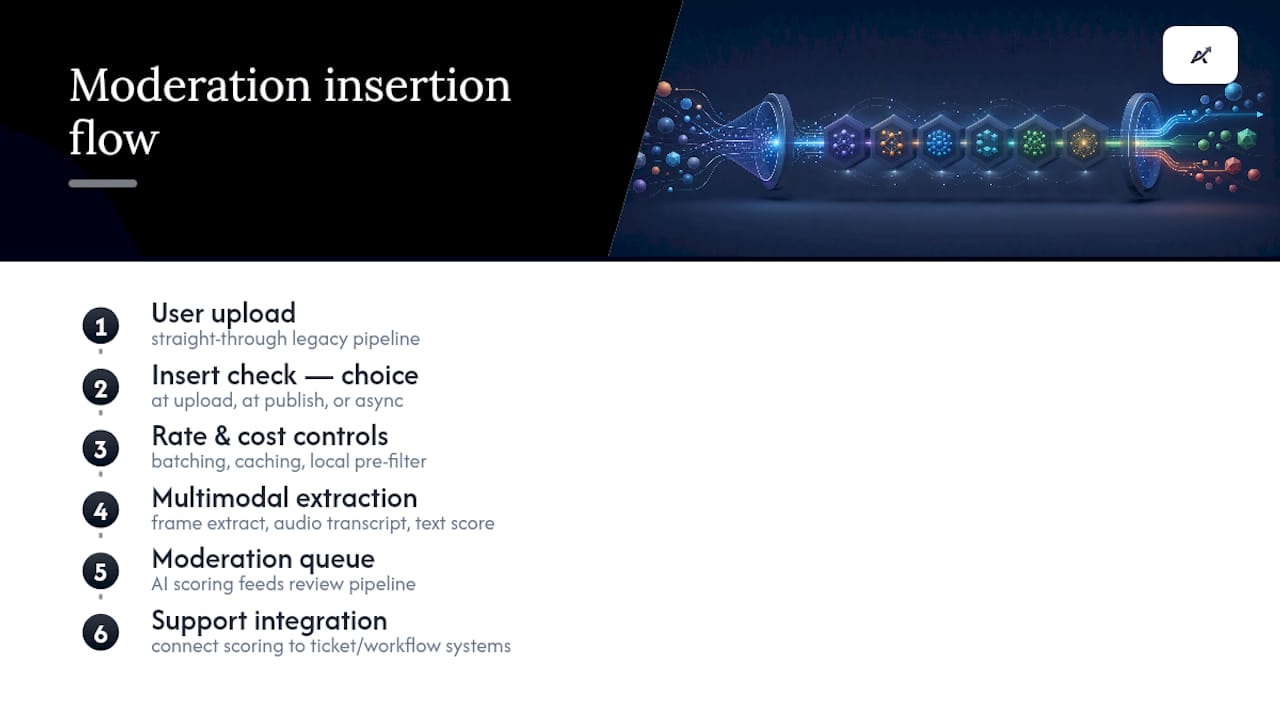
API rate limits and cost structure create a second layer of friction. A platform processing millions of daily uploads cannot naively call an external classification endpoint on every item without hitting either a rate ceiling or a cost curve that makes the business case fall apart. Batching, caching repeated content signatures, and pre-filtering with a lightweight local model before escalating to a heavier API call are common workarounds, but each adds engineering complexity the original architecture never anticipated.
Data format mismatches compound the problem for multimodal content. A video upload pipeline built for compression and CDN delivery was not designed to extract frames for image analysis or transcribe audio for text scoring, so integration often means building an entirely parallel extraction path just to feed the moderation layer the inputs it needs.
Finally, existing moderation queues and support ticketing systems rarely speak the same language as a new AI scoring layer out of the box, which is exactly why full-stack platforms bundling API, dashboard, and workflow in one integration point have found real demand among teams unwilling to stitch four vendors together themselves.
What Have Real Moderation Failures and Wins Taught Us?
The clearest lesson from platforms that have publicly struggled with moderation is that automation failures rarely stay contained to one bad decision. A single over-aggressive removal that catches a journalist, a medical educator, or a satirist tends to surface publicly and fast, because the affected user has every incentive to publicize an unfair takedown, and screenshots travel further than corrections.
The pattern shows up repeatedly with health and body content. Automated systems trained to catch policy violations around nudity or graphic imagery have a documented history of misclassifying breast cancer awareness posts, breastfeeding photos, and clinical educational material as violations, precisely the bias risk described earlier in this piece, because the classifier pattern-matches on visual similarity rather than context or intent.
On the success side, the platforms that have avoided major public incidents share a common trait: a working appeals process that actually overturns wrongful decisions, publicly and quickly enough that users trust the system is not just theater. When an appeal genuinely reverses a bad call within hours rather than weeks, it signals the human-in-the-loop layer is not decorative, it is doing real work catching what the AI got wrong. That reversal rate, not the initial detection accuracy, is often the better measure of whether a moderation system deserves user trust.

The quieter wins are harder to publicize but arguably more common: hybrid systems that auto-clear the large majority of routine content with no ambiguity, freeing human reviewers to spend their attention entirely on the genuinely hard calls, which is the entire point of the hybrid model in the first place.
The Perspective Nobody Wants to Hear About Moderation Vendors
Most teams evaluating AI content moderation start by comparing model accuracy scores across vendors, and that is the wrong first question. Model accuracy converges faster than people expect; the gap between a decent classifier and a great one is measured in single-digit percentage points on most benchmarks. The gap between having an audit trail and not having one is measured in whether you survive your first public incident with your credibility intact.
Instrument the appeals rate and time-to-resolution before you have a scale problem, not after. Teams that wait until reviewer fatigue or a bias complaint forces the issue end up building the harness under pressure, with worse decisions baked in from the start. And protect the humans in your loop deliberately: rotate reviewers off graphic content queues, and treat their judgment as the actual safety net, not a stopgap until the model improves.
— Task
Sources
- OpenAI moderation guide — Developers
- 6 types of AI content moderation and how they work — TechTarget
- Azure Content Moderator overview — Microsoft Learn